The Intel Brief · Transmission 002
The P-3 Orion: Six Decades of the Long Watch
· 3 min read
The Navy needed something that could stay airborne long enough to outwait a submarine. Lockheed did not design one. They took an airliner and rebuilt it into a hunter, and the result flew for six decades.
An airliner with a different job
The P-3 came out of the L-188 Electra, Lockheed’s four-engine turboprop airliner. The aerodynamic prototype flew on 19 August 1958, the P-3 itself followed in November 1959, and the type entered Navy service in August 1962 replacing the P-2 Neptune.
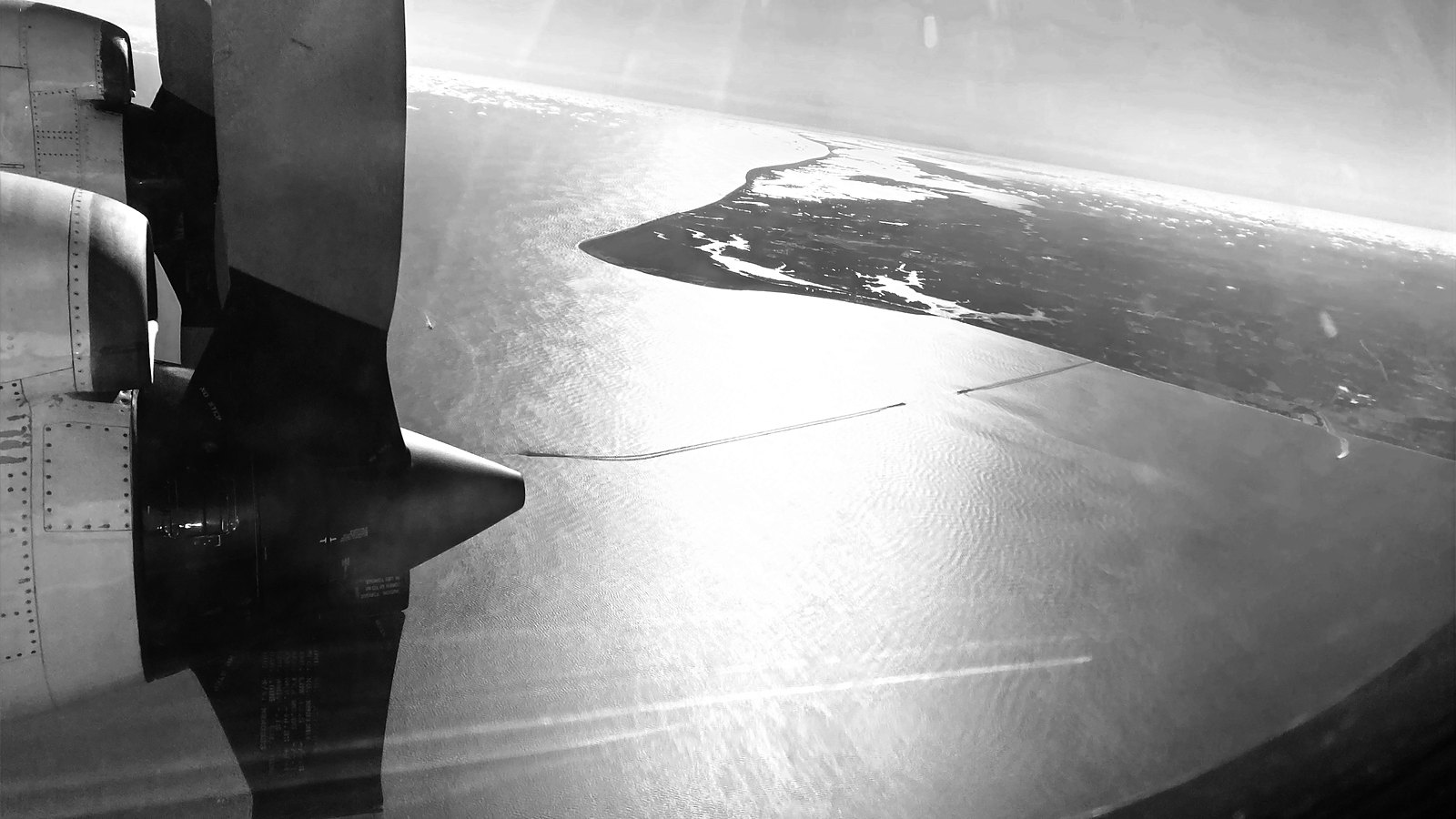
It is not a repainted Electra. The forward fuselage lost seven feet, a weapons bay went in, the nose took a pointed radome, hardpoints went under the wings, and the tail grew the stinger everyone recognizes: the Magnetic Anomaly Detector boom, hunting the disturbance a steel hull leaves in the earth’s magnetic field. Four Allison T56 turboprops, the same engine family that hangs on a Hercules.
Built to wait
Submarines do not run. They hide, and they are patient. The Orion answered that with endurance, loitering for ten to twelve hours at low altitude over open water, which is a long time to sit in the back of an airplane listening.
That is the part people outside the community miss. The airplane is a sensor platform first and an aircraft second. Sonobuoys, acoustic processing, surface search radar, electronic support measures, infrared. The crew in the tube behind the flight deck is doing the actual work, and the aircraft exists to keep them on station.
Where it went
Orions flew coastal interdiction under Operation Market Time beginning in 1964. They spent the Cold War tracking Soviet boats. They flew maritime surveillance and targeting support in the Gulf in 1990 and 1991. Between 1961 and 1990, 757 were built, 650 by Lockheed and 107 under license by Kawasaki in Japan, and they went to navies across the world.
Still flying
The Navy has moved to the P-8 Poseidon, but the Orion did not stop. NOAA still flies two WP-3D hurricane hunters, in service since 1976, straight into storms that everything else is running from.
NASA flew the type too. A P-3B, N426NA, served out of Goddard’s Wallops Flight Facility in Virginia as an Earth science platform for the Airborne Science Program, carrying instrument payloads on research campaigns rather than sonobuoys. The traits that made it a good submarine hunter, endurance, low-altitude stability, and a cabin with room to work, make it an equally good flying laboratory.
U.S. Customs and Border Protection runs P-3s on long-range surveillance. Several allied navies are still on the type.
Sixty-plus years from a design that started as a passenger airplane, and the airframe is still finding work.
A note
DA’s founder crewed these airplanes at NASA as an aft crew member, in the back where the mission actually happens. Some of what shapes this company started in that tube: the discipline, the checklist, and the understanding that the equipment is only as good as the people running it.
It is a beautiful airplane. Not because it is pretty, but because it was honest about what it was for.